November 2, 2026Ceren Kaya Akgün
Who Is Responsible When AI Makes a Mistake?
Who is responsible when AI makes a mistake? Six rulings and rules, 2,247 court decisions and five questions to answer first. Watch the 1-minute demo.
Who is responsible when AI makes a mistake? A small claims court was asked about a chatbot. A man looking for flights to a family funeral had asked Air Canada's website chatbot about bereavement fares. It said he could buy a ticket and claim the discount afterwards. Staff later said the fare could not be applied after the fact, and the airline's own site agreed.
The airline argued that it could not be bound by what its chatbot said. The court rejected that and held the airline responsible, as it would be for any other information on its website, according to Duke Law's July 2026 write-up of a paper on agency law that describes Moffatt v. Air Canada.
So, usually, the organization that put the AI to work answers for it, and inside it the people who authorized the action or signed off on it. That sentence is true and nearly useless to a manager with an agent going live on Monday, because it does not say which person answers, or what that person can show when asked.
This post is for the people whose team puts AI to work and whose name gets asked for afterwards: operations, HR, finance, support and legal leads, small business owners and the founders who set these things up. You do not need to read code.
It covers the short answer, six rulings and rules, a count of 2,247 court decisions, who answers inside a company, a five-question file to keep, what that file looks like in Heym Work, five decisions for Monday, and where insurance and vendor contracts fit.
It is not legal advice and it does not compare products. The rulings come from the United States and the European Union, and other places differ. Where a case is early, the post says so.
The short version:
- An AI cannot answer for itself. According to Duke Law, an AI cannot owe a duty to anyone or act as a legal agent, so the question goes to the people and companies behind it
- The rulings point behind the AI. Air Canada answered for its chatbot, California bars the defense that an AI "autonomously caused the harm," a US appeals court treated the user as the actor when an agent browsed Amazon, and a vendor was sued as its customers' agent
- The person who files it is the person addressed. Of 2,247 court decisions on AI-hallucinated material logged by 28 October 2026, 1,294 concern self-represented people and 879 concern lawyers
- Inside companies nobody agrees who owns it. In a PwC survey of about 4,000 leaders, answers split four ways: the CIO or CTO (29%), a dedicated AI leader (26%), the CISO (17%) and unclear (11%)
- Five questions sit under every decision: what the agent was told, what it was allowed to touch, what it did, who said yes and what you did next. Five records answer them, and we call the set an answer file
- A date is coming. The EU Product Liability Directive applies to products placed on the market from 9 December 2026, and it covers software, AI systems included
- A one-minute video shows the file in Heym Work: run history, reviews, saved versions and a stop button
What Heym is: Heym is a source-available, self-hosted AI agent platform with a visual canvas for multi-agent pipelines, RAG and MCP. Heym Work is its interface for business teams. What this post says about records comes from Heym's documentation and source on 2 November 2026. The court and survey figures come from public sources listed at the end.
Table of Contents
- Who Is Responsible When AI Makes a Mistake? The Short Answer
- Who Is Liable When an AI Agent Makes a Mistake? Six Rulings and Rules
- 2,247 Court Decisions, One Pattern: The Person Who Filed It Answers
- Who Is Accountable When AI Makes a Mistake Inside a Company?
- The Answer File: Five Questions Behind Every Ruling
- What an Answer File Looks Like in Heym Work
- Before the Mistake: Five Decisions for Monday
- AI Agent Liability Insurance and Your Vendor Contract
- What the Law Has Not Settled
- Where This Leaves You
- Frequently Asked Questions
- Sources
Who Is Responsible When AI Makes a Mistake? The Short Answer
In the rulings and laws below, the organization that put the AI to work is the party held to account, and inside it the question lands on whoever authorized the action or signed off on it. An AI is not a legal person, so claims go to people and companies. What you can show affects who is asked to answer.
Can AI be held liable? Duke Law's write-up of a paper by Deborah A. DeMott, a Duke Law professor and expert in agency and fiduciary duty, says not in the way a person or a company can: an AI cannot owe a duty to anyone or act as a legal agent on behalf of someone else.
DeMott compares an AI agent to a dog trained to bark and growl on command: not a legally culpable person, but its owner's instrumentality. On that view, the tool did the thing and the owner answers.
The law firms read it the same way. Baker McKenzie's 1 July 2026 briefing on US law says emerging legal developments "support the view that accountability generally runs to the humans and entities behind the agent." It adds that companies "will be expected to govern, monitor, and explain what their AI agents do."
An AI agent is software that acts toward a goal on a person's or company's behalf: it sends, books, buys or changes a record, and does more than answer. Baker McKenzie's summary is that agents "pull AI from content into conduct." That is why the question moved from chatbots to every team that runs one.
Three roles sit behind an AI. The developer built it, the deployer runs it for a purpose, and the user directs it on a task. The rulings below look at all three, and they answer who is liable when an AI agent makes a mistake differently for each role. For most readers of this post the deployer is you, which is why who is responsible if AI makes a mistake in your company is worth answering before it happens.
Who Is Liable When an AI Agent Makes a Mistake? Six Rulings and Rules
Who is liable when AI goes wrong is not settled by one case, so here are six matters side by side, each read from its own source on 2 November 2026. Together they are a map of AI agent legal liability today. One is a small claims ruling, two are court matters that are still early, and three are statutes and directives that reach it. The table says who the court or the law looked at.
| Matter | Date | Who the court or law looked at | What decided it |
|---|---|---|---|
| Moffatt v. Air Canada | 2024 | The airline that published the chatbot | The chatbot was part of its website, so the airline answered for it as for any other page |
| E-SIGN Act | 2000 | The person the agent's action is attributable to | A contract keeps its force when an electronic agent acted, so long as the action is attributable to the person bound |
| California AB 316 | Chapter 672, 2025 | Whoever developed, modified or used the AI | The defense that the AI autonomously caused the harm is barred, and other defenses stay open |
| Amazon v. Perplexity AI | Ninth Circuit, 4 August 2026 | The user | The user, not Perplexity, accessed Amazon using the agent as a tool, at a preliminary stage |
| Mobley v. Workday | N.D. Cal., ongoing in 2026 | The vendor, as the employers' agent | Claims that Workday acted as an agent of its customers proceed, with no ruling on the merits |
| EU Product Liability Directive | Applies from 9 December 2026 | The manufacturer of the software | Software, AI systems included, is covered, and a defect present at release is enough |
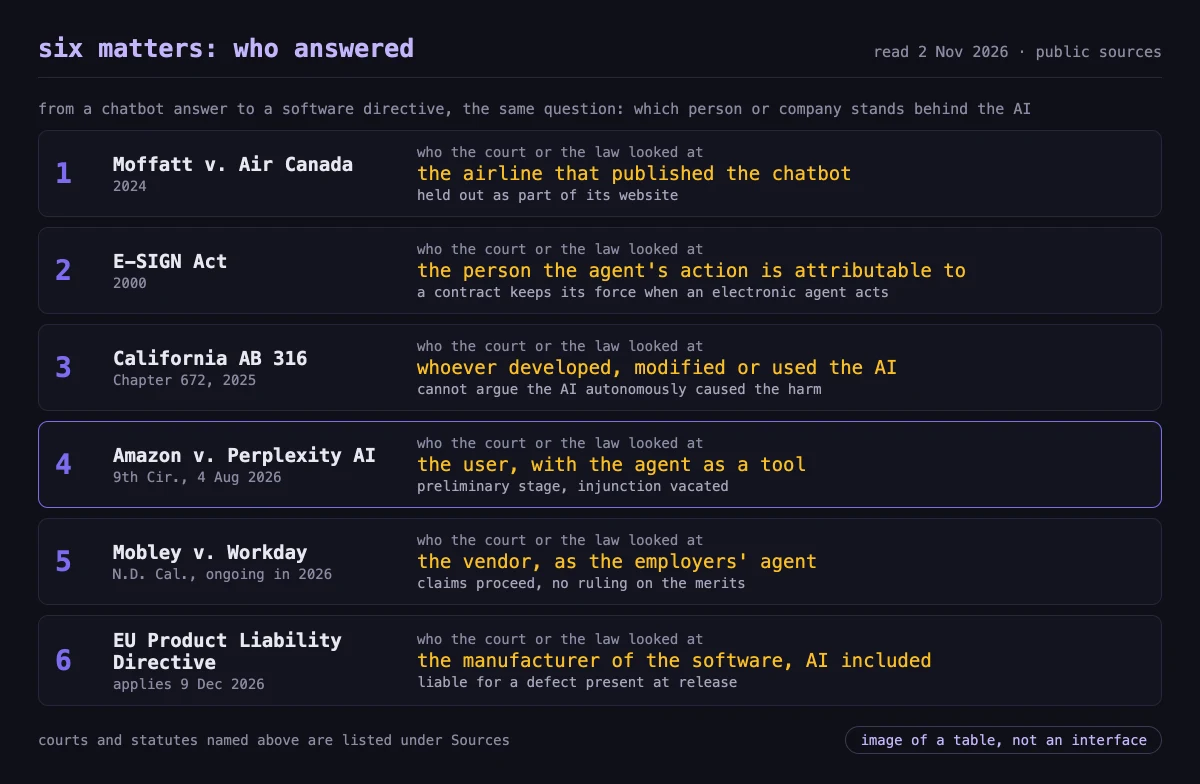
The rows differ on who, and agree on what they look for: a person or a company standing behind the AI, and a record of what that party allowed or did. Five short sections take them one at a time.
A Chatbot Is Part of the Website: Moffatt v. Air Canada
The airline's argument was that the chatbot was separate from the company. DeMott writes that the airline's liability turns on "its creation of what appeared to be a legally consequential way for third parties to communicate with it." In plain words, on DeMott's reading, if a customer can reasonably take your agent's words as yours, they are yours.
The case travels well because it has no technology in it. The question the court asked is what the customer saw, and where. Wikipedia's article on the case drew 2,728 views in October 2026, up from 890 in September, so it is back in conversation.
Two Rules That Close the "The AI Did It" Door
The E-SIGN Act of 2000 already covered software that acts. Baker McKenzie notes that a contract cannot be denied legal effect solely because an electronic agent was involved, "so long as the action of any such electronic agent is legally attributable to the person to be bound." Courts still decide when attribution is appropriate, it adds.
California's AB 316, Chapter 672 of the Statutes of 2025, says that in a lawsuit over harm caused by AI, "it shall not be a defense, and the defendant may not assert, that the artificial intelligence autonomously caused the harm to the plaintiff." It applies to a defendant who developed, modified or used the AI. Other defenses stay open, including evidence about causation and foreseeability.
A committee analysis reproduced on the same page said it was unaware of any US case where an AI autonomy defense had been raised, let alone succeeded. The law arrived before the argument did. Can AI be held liable on its own? The statute does not go there. It removes one defense, so the people who developed, modified or used the AI cannot point at the AI.
The User Is the Actor: Amazon v. Perplexity AI
Amazon sued Perplexity over its agentic browser, which can shop on a user's behalf. A district court enjoined the agent at first. The Ninth Circuit vacated that injunction on 4 August 2026, writing that "Amazon is unlikely to succeed in showing that Perplexity 'accessed' Amazon computers for CFAA purposes."
On the facts before it, the court wrote, "the user (not Perplexity) accesses Amazon using the Assistant as an AI tool."
This is an early ruling under a narrow federal computer-access law, and the case goes back to the district court. What it adds is a view from the other direction: when an agent acts on someone else's site, the court looked first at the person who directed it. If your staff run browser agents on other companies' sites, that person is the one a court may look at first.
The Vendor as Agent: Mobley v. Workday
In Mobley v. Workday, the question is whether a technology vendor can face liability under anti-discrimination laws when its tools allegedly influence hiring decisions made by employers. The court let claims that Workday acted as its customers' agent go forward, because the customers plausibly delegated hiring functions, including screening and recommending candidates, to the vendor's tools, as Legal 500 summarizes. In May 2025 it granted preliminary certification of a nationwide age discrimination collective.
These are the plaintiffs' allegations, and none has been proven. In June 2026 the judge largely denied Workday's latest effort to dismiss amended claims, according to FMG Law. There is still no ruling on the merits, and Legal 500 cautions that this "doesn't mean every AI vendor becomes its customer's legal agent."
Our reading: the theory is delegation. When you hand a tool a decision you used to make, the vendor is not the only party in the picture, and who is liable for AI mistakes made through a vendor's tool is the part still being argued.
Software Becomes a Product: The EU Directive
The EU Product Liability Directive is the law that lets a person claim compensation from the manufacturer of a defective product that caused damage. The revised version, Directive (EU) 2024/2853, is the one rule on the list with a date.
According to the European Commission, it clarifies that all types of software are covered, "including applications, operating systems and AI-systems," and that manufacturers can be held liable for a defect that existed when the software or AI system was released. EU countries have until 9 December 2026 to transpose it, and it applies to products placed on the market from that day.
The Commission's summary also lists new tools for requesting evidence in court and an easier burden of proof where needed. Our reading is that this is one more reason to hold your own records. Whether a company's own use of an agent counts as placing a product on the market depends on the facts, so ask counsel.
2,247 Court Decisions, One Pattern: The Person Who Filed It Answers
Six matters is a small sample. For one narrow kind of AI mistake there is a much larger count: hallucinated material in court filings, meaning output a model made up, such as a case citation that does not exist, presented as if it were real.
The researcher Damien Charlotin keeps an open database of court and tribunal decisions that address such material, licensed under CC BY 4.0. We downloaded the CSV on 2 November 2026 and aggregated it ourselves, so the numbers below are our counts and not the database's own statistics.
It held 2,247 decisions dated from 14 April 2023 to 28 October 2026. Courts have been answering who is responsible for AI errors in this one place for three years, and the Party column records who used the AI:
- 1,294 decisions (57.6%) concern a self-represented litigant
- 879 (39.1%) concern a lawyer
- 26 concern a judge, 17 an expert and 31 a mix of other roles
The count is growing fast: 16 decisions in 2023, 61 in 2024, 865 in 2025 and 1,304 in 2026 up to 28 October, between 107 and 184 a month from January to September 2026. A back-of-envelope projection, assuming that pace holds: 753 more rows take the database past 3,000 in about four months at 184 a month and about seven at 107, so between March and June 2027.
How we counted: the Party column says who used the AI, the Date column gives the year, and the Vendor Disputed, Professional Sanction and Alleged columns carry the flags. We counted rows as they are, with none removed. Rows that name two roles, or none, sit in "other roles."
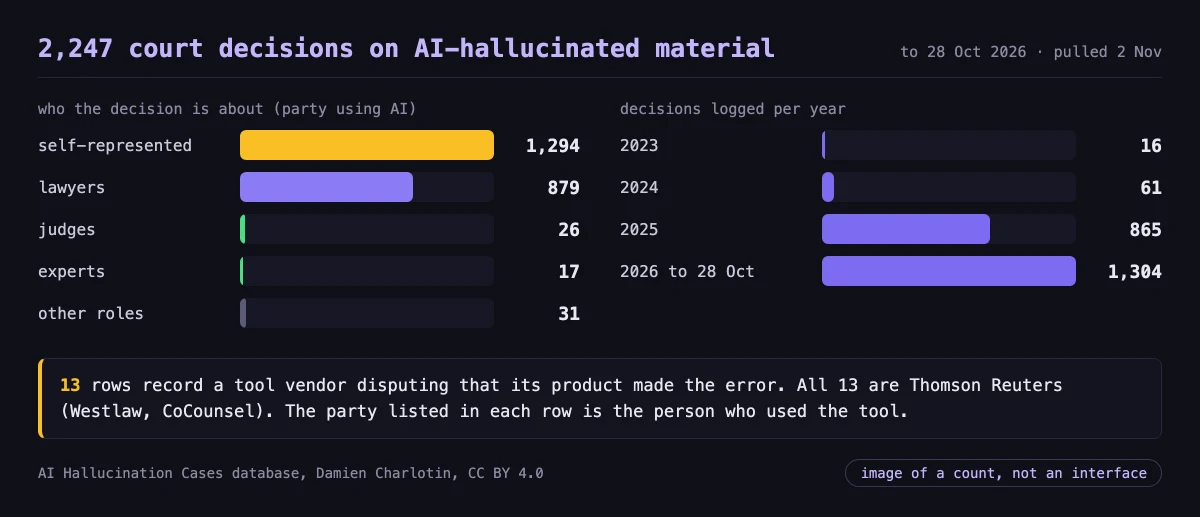
One column is about vendors. In 13 rows a tool vendor disputed that its product made the error, and all 13 are Thomson Reuters, which said in the database's notes that its tools did not produce the errors. The party listed in each of those rows is still the person who used the tool.
The database cannot show everything. It covers court filings only, and it records who used the AI, not who ended up paying. Warnings are the most common recorded outcome (538 rows) and 478 rows record none. A professional sanction is marked in 165 rows, and 25 rows are marked as alleged, not established. The pattern is the finding, not the total.
Our reading for an operator: who is accountable for AI generated work at your company is the person whose name is on it. In these decisions the court's attention stayed on the person who filed. An email or a report that an agent sends under your company's name carries a name too.
Who Is Accountable When AI Makes a Mistake Inside a Company?
Outside the company, the organization answers. Inside it, who is responsible for AI agents is a question no court settles for you, and who is accountable when AI makes a mistake is a question executives answer differently from one another.
PwC's Digital Trust Insights 2027 surveyed about 4,000 business and tech leaders in 71 countries, and ZDNET reported it on 6 October 2026. No single role had clear responsibility for managing agentic AI or its security. Of the CEOs and security and risk leaders, 29% said accountability sits with the CIO, CTO or a similar technology role. Other respondents put it with a dedicated AI leader or function (26%), the CISO or security teams (17%), or said it is unclear and shared across roles (11%).
A new title does not settle it: about a third of the organizations PwC surveyed (33%) had hired for dedicated AI roles, including AI chief officers and AI board members, and accountability still split four ways.
A Dataiku and Harris Poll survey of 685 CIOs in eight countries, summarized by Kovrr on 1 November 2026, found that 84% say employees are building AI agents and applications faster than IT can govern them. Also, 60% have no central governance layer across their applications and environments. Jim Taylor, Chief Product and Strategy Officer at RSA, told ZDNET that agents "won't be held in compliance violations" but "the organization will."
So the useful question is not which title wins that argument. It is whether, for each agent, three people are named before the mistake: the one who authorized what it may do, the one who approves the actions that matter, and the one who runs it day to day. Who is accountable for AI decisions inside the company is then a list of three names, not a debate.
In a small business one person holds all three hats. That is fine, and it is still worth writing down which hat made which decision. Enterprise AI Agents takes the ownership question further for larger companies.
The Answer File: Five Questions Behind Every Ruling
An answer file is one page per AI agent that answers five questions, kept where your team can open it. A file that answers who is responsible for AI mistakes in your company has to be written before the mistake, because afterwards the only version is memory.
The questions come from the sources above. Baker McKenzie says the practical questions are what permissions, credentials, instructions, workflows and system access a company or employee gave an AI agent, and how its authority was presented to the people it dealt with. Add what the agent did, who approved it and what happened next, and you have five.
| Question | Where a source asks it | The record that answers it |
|---|---|---|
| What was it told to do? | Baker McKenzie: instructions and workflows | The instructions, and the version in force on the day |
| What was it allowed to touch? | Baker McKenzie: permissions, credentials and system access | The credentials, tools and data it had, the limits on it and who could change them |
| What did it do, and what did the other person see? | Moffatt: how the chatbot was presented. E-SIGN: whether the action is attributable | The run with its trigger, inputs, steps and outputs, and the message as sent |
| Who said yes? | Baker McKenzie: human oversight and logs. The court filings: the person who signed | What was proposed, what the reviewer changed, the decision and the time |
| What did you do next? | Baker McKenzie: govern, monitor and explain | The stop, the fix, the correction to the other person and the dates |
This is our grouping of what the sources ask for. It is not a legal test, and a lawyer may ask for more.
The worksheet is one row per agent, and its Owner field is where who is accountable for AI decisions gets written down. Copy it into a document or a sheet.
| Field | Write down |
|---|---|
| Agent and purpose | One sentence |
| Owner | One named person, not a team |
| Instructions | Where they live, and which version is live |
| Allowed to touch | Systems, credentials, data, and sending or spending limits |
| Needs a person for | The actions that wait for approval, and who approves |
| Where runs are recorded | The place where a run's inputs, steps and outputs can be opened |
| Keep for | How long, decided with counsel |
| Who can stop it | And how |
A new agent without a filled row is the gap. The next section shows the same five records in a product.
What an Answer File Looks Like in Heym Work
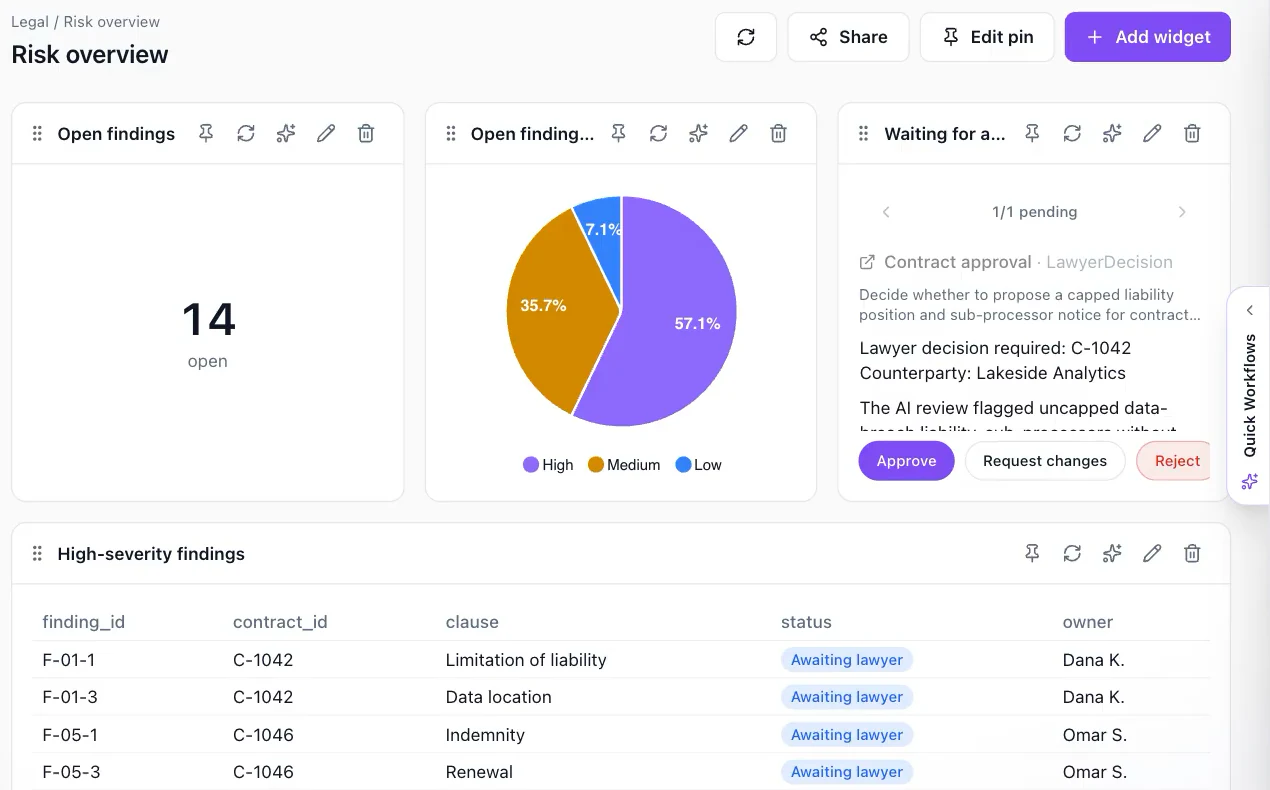
Heym Work, introduced in Introducing Heym Work, is the business interface to Heym. A team builds workflows by asking for them, runs them, follows every run and approves what matters. The one-minute video below shows the Legal edition with demo content: contract intake, an AI risk review and a lawyer's approval. The companies and contracts are fictional.
The chapters line up with the file: who runs what, at 0:15, and follow, fix and approve, at 0:41. The rest of this section walks the five questions through what Heym's documentation lists.
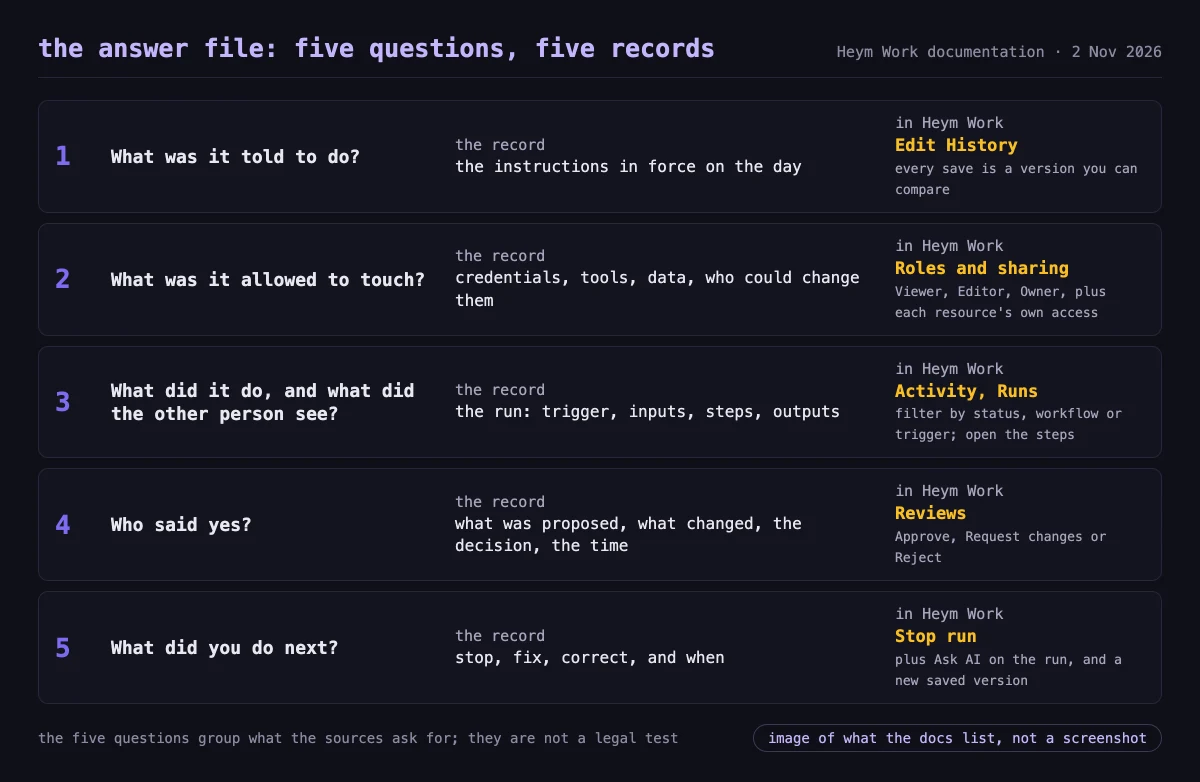
What was it told to do? Edit History keeps a version for each save of a workflow, shows what changed between versions and lets you preview or revert to an earlier one. The Workflow Change Audit Log template posts a Slack summary whenever a workflow is created, updated or deleted on your instance, a running record of what changed, when and who changed it.
What was it allowed to touch? In Work, a member's role (Viewer, Editor or Owner) and the resource's own Heym permissions both apply, so being an Editor does not automatically give write access to every shared page or workflow. Editors and Owners manage the credentials Work uses, and credential sharing lets you share a credential with a user or a team.
What did it do, and what did the other person see? Activity lists runs and filters them by period, status, workflow or trigger. An entry shows its status, start time, duration and trigger. When available, the detail also names the instance that executed it and shows the steps with their recorded inputs and outputs. Execution History stores each run's inputs, outputs, node results, status and trigger source, and the Traces tab shows model requests, responses and tool calls, which AI Agent Observability covers in depth.
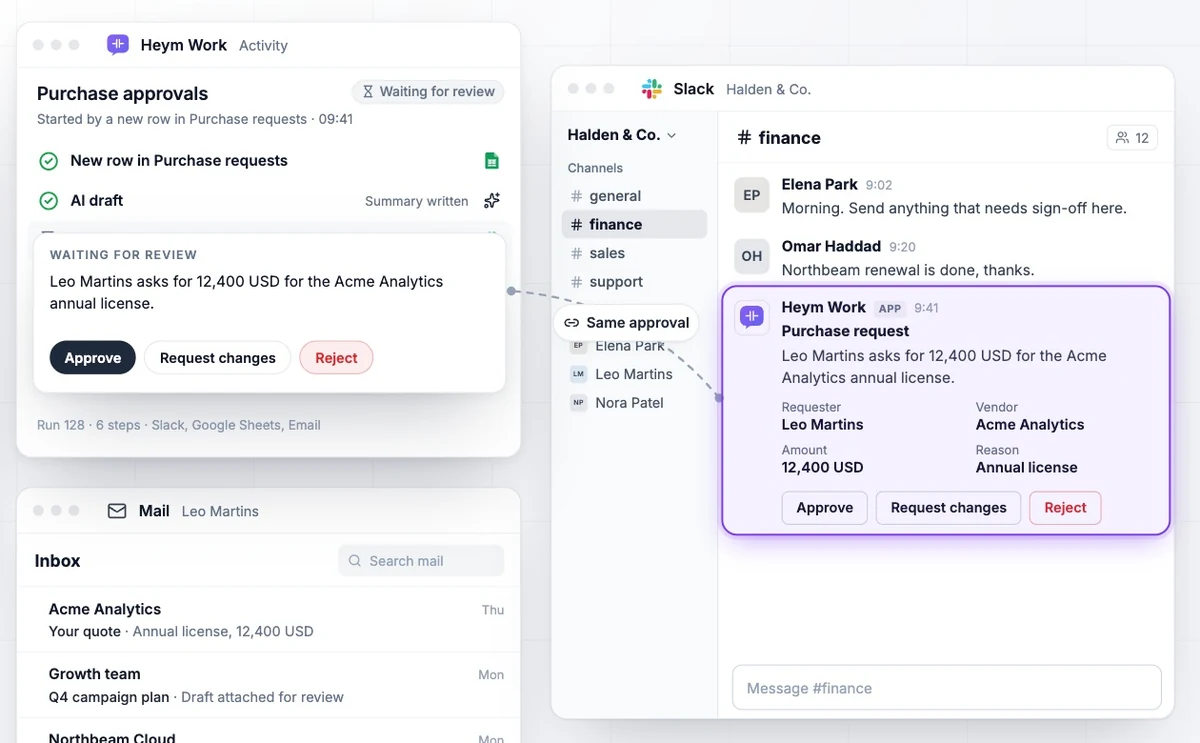
Who said yes? An agent with human review turned on pauses and sends a one-time review link. The reviewer chooses Accept, Edit & Continue or Refuse, and once a decision is submitted the link is locked (Human-in-the-Loop). The review keeps the agent's original draft, the reviewer's edit, the decision and the time it was made. In Heym Work the same review appears in Activity as Approve, Request changes or Reject, and your role and access decide which reviews you can act on.
Approvals do not have to live in one place. In Flows, an approval requested in Slack also appears in Activity, and a decision there updates the Slack message. The frame below shows the same waiting purchase request in both, and the Slack approval workflow post walks through it.
What did you do next? A live run can offer Stop run. A stopped run and the side effects it had already completed stay in history, and Ask AI opens Chat with that run attached, so you can ask about the failure without starting a replacement run.
To try a review step, import PTO Request Approval (Human-in-the-Loop): an agent checks a request against policy, then pauses for a manager to approve, edit or refuse. For the kind of legal intake the video shows, Contract Risk Review Queue summarizes pasted contract text, flags risky clauses and sends review-needed items to Slack. It is a triage aid, not legal advice.
Before the Mistake: Five Decisions for Monday
Who is responsible for AI errors on a given morning is decided by five choices made earlier. Each takes minutes.
- Name one owner per agent. A person, not a team. Who is responsible for AI agents should never be answered with a group name. AI Agent Governance goes further on owner, purpose, boundary and shutdown.
- Write down what it may do without asking. Sending, spending, deleting and contacting people outside the company, in numbers. AI Agent Spending Limits shows why a decline is not a decision.
- Choose which actions wait for a person, and send each review to a named person. Too many gates and reviewers stop reading, which Human in the Loop AI Agents covers, and the Slack approval workflow shows approvals landing where people already work.
- Decide how long the record lives and who may clear it. In Heym the person who owns a run can clear its history, so keep that to the owner and set the period with counsel.
- Know where Stop is, and who may press it. Test it once, in daylight. How to Stop AI Agents Going Rogue has a test you can run.
Then run the fifteen-minute file check. Pick one agent that already runs and fill its worksheet row from what you can open, not from memory. The first row you cannot fill is the first fix. Decide before, not after, who is responsible if AI makes a mistake in that agent. If the agent writes to people outside the company, start there, and read How to Avoid AI Slop for a check before the send.
AI Agent Liability Insurance and Your Vendor Contract
AI agent legal liability and AI agent liability insurance are two questions, and the second depends on the first. Insurance is moving fast. ZDNET reported on 30 October 2026 that AIG, Great American, WR Berkley and other major insurers are working with US regulators to add AI exclusions to their policies. It adds that there are "troubling discrepancies between what providers advertise and what their policies cover."
A June 2026 paper, Insurance of Agentic AI by Quanyan Zhu, argues that agentic AI creates exposures that do not fit neatly into cyber, professional liability, product liability or directors and officers cover. It proposes layered coverage supported by governance, transparency and telemetry, which is what an answer file records.
Your vendor contract is the other half. Who is liable for AI mistakes between you and a vendor is a question for the contract: read what the terms say about who carries the risk when the model is wrong, and ask counsel to read them too. Mobley v. Workday shows a vendor can be pulled into a case, and Legal 500 notes that this does not make every vendor its customer's agent.
What the Law Has Not Settled
- Amazon v. Perplexity AI is early. The Ninth Circuit vacated a preliminary injunction, and the case returns to the district court for further proceedings.
- Mobley v. Workday has no ruling on the merits. Claims are proceeding, and the court has not said that every vendor is its customer's agent.
- The EU directive still has to become national law. EU countries have until 9 December 2026 to transpose it, and national rules will differ in detail.
- Model makers are a separate question. MIT Technology Review reported on 28 September 2026 that state AI transparency laws in California, New York and Illinois require developers to report only critical safety incidents, defined as incidents that cause more than 50 deaths or physical injuries or $1 billion in damage, and that state attorneys general are borrowing investigative powers from consumer protection and other laws to demand information from a model maker about a recent incident. The piece asks how companies can be held liable when they lose control of their agents. Who is liable when AI goes wrong at a model maker is still open.
Where This Leaves You
Who is responsible for AI mistakes has a short answer and a long afterwards. In the sources we read, the short answer is the organization, and inside it the person who authorized or approved the action. In the decisions we counted, who is accountable for AI generated work is the name on it. The long afterwards is a file.
Air Canada was asked what its chatbot said and where. A user was asked what an agent had been directed to do. A vendor was asked what it had been handed to decide.
This week, pick one agent, fill one row of the worksheet in fifteen minutes and write the date next to the gaps. If you run Heym Work, the video above shows where each record lives, and you can request a trial to see it on your own agents. Mark 9 December 2026 as well: the EU directive applies from that day, and we will update this post then.
General information, not legal advice. A software company wrote this on 2 November 2026 from the public sources listed below. It does not create a lawyer-client relationship, it may be out of date, and rulings and laws differ between countries and states. Ask a qualified lawyer about your own situation.
Frequently Asked Questions
Who is responsible when AI makes a mistake?
In the rulings and laws we read, the organization that put the AI to work is held to account for what it does, and inside it the question lands on whoever authorized or signed off on the action. An AI is not a legal person, so claims go to people and companies, and its maker is only sometimes added. This is general information, not legal advice.
Who is liable when an AI agent makes a mistake?
Usually the company that deployed the agent, as in Moffatt v. Air Canada, and sometimes the person who directed it: in Amazon v. Perplexity AI a US appeals court treated the user, not Perplexity, as the one who accessed Amazon through an agent. A vendor can be sued when a customer handed it a decision, as in Mobley v. Workday. Both of those matters are still early.
Can AI be held liable?
Not as a legal party, according to the sources we read. Duke Law's write-up of agency law expert Deborah DeMott says an AI cannot owe a duty to anyone or act as a legal agent on behalf of someone else, so the law looks for a person or a company behind it. California's AB 316 goes one step further: a defendant cannot argue that the AI autonomously caused the harm.
Who is accountable for AI decisions inside a company?
There is no standard answer yet. In a PwC survey of about 4,000 leaders, answers split four ways: the CIO or CTO (29%), a dedicated AI leader (26%), the CISO (17%) and unclear (11%). For each agent, name three people before a mistake: who authorized what it may do, who approves the actions that matter and who runs it.
Who is accountable for AI generated work?
In the court decisions we counted, the person whose name goes on it. Of 2,247 decisions on AI-hallucinated material logged by 28 October 2026, 1,294 concern self-represented people and 879 concern lawyers, and the party listed is the one who used the AI. At work, the same logic is a fair one to apply to a report or email sent under a name.
Who is liable for AI mistakes, the user or the vendor?
Usually the party that used or deployed the AI, and sometimes the vendor. Vendors have been sued, as in Mobley v. Workday, where claims that Workday acted as its customers' agent are proceeding, but a Legal 500 commentary notes this does not make every AI vendor its customer's agent. Between you and a vendor, the contract decides who carries the risk, so ask counsel to read it.
Do I need AI agent liability insurance?
It depends on what the agent can do and what your current policies already cover. ZDNET reported on 30 October 2026 that AIG, Great American, WR Berkley and other major insurers are working with US regulators to add AI exclusions to policies. Ask your broker in writing whether an agent's actions are covered, and keep your answer file ready to show what the agent was allowed to do.
What does the EU Product Liability Directive change for AI?
From 9 December 2026 it applies to products placed on the market and covers all types of software, including AI systems. Manufacturers can be held liable for a defect that existed when the software was released, and courts get new tools to request evidence. EU countries must transpose it into national law by 9 December 2026.
What should I record so I can show what an AI agent did?
Five things: the instructions in force, what the agent was allowed to touch, the run with its inputs, steps and outputs, who approved what and when, and what you did next. We call the set an answer file: one row per agent, kept where your team can open it.
Does Heym keep these records?
Yes. Edit History keeps a version for each save, Execution History stores each run's inputs, outputs, node results, status and trigger, and human review keeps the agent's draft, the reviewer's edit, the decision and its time. Heym Work shows runs and reviews in Activity, with a Stop run button for live runs.
Sources
All sources were read on 2 November 2026.
- Duke Law, Legal Liability and Agentic AI: How the Law Applies When Bots Go Rogue, 27 July 2026.
- Baker McKenzie, United States: Legal Accountability for AI Agents, 1 July 2026.
- United States Court of Appeals for the Ninth Circuit, Amazon.com Services, LLC v. Perplexity AI, Inc., No. 26-1444, opinion of 4 August 2026.
- California Legislature, AB 316: Artificial intelligence: defenses, Chapter 672, Statutes of 2025, bill page on Digital Democracy.
- Legal 500, AI Vendor Liability After Mobley v. Workday: When Risk Doesn't Follow Control, 31 August 2026.
- FMG Law, The Workday AI litigation moves forward: what employers should learn before the courts decide vendor liability, 2 July 2026.
- European Commission, Liability for defective products, Directive (EU) 2024/2853.
- Damien Charlotin, AI Hallucination Cases, database under CC BY 4.0, CSV downloaded on 2 November 2026 with rows to 28 October 2026. The counts in this post are our aggregation of that CSV.
- MIT Technology Review, Who's liable when AI agents go rogue?, 28 September 2026.
- ZDNET, Charlie Osborne, Who owns AI risk at work? Business and tech leaders can't agree, PwC survey finds, 6 October 2026.
- Kovrr, Accountable for AI the CIO Never Approved, 1 November 2026, summarizing a Dataiku and Harris Poll survey of 685 CIOs.
- ZDNET, Do you need AI agent liability insurance? What to know before you sign up, 30 October 2026.
- Quanyan Zhu, Insurance of Agentic AI, arXiv:2606.05449, 3 June 2026.
- Wikimedia REST API, Pageviews of Moffatt v. Air Canada on English Wikipedia, September and October 2026.
- Heym Work, Heym Work in one minute, video of 31 October 2026 on the Legal edition with demo content.
Steps at a glance
- Name one owner. Write one named person next to the agent, not a team. That person answers for what the agent may do.
- Write down the limits. List what the agent may do without asking: sending, spending, deleting and contacting people outside the company, with numbers.
- Choose what waits for a person. Decide which actions pause for approval and send each review to a named reviewer.
- Find where runs are recorded. Open the place where a run's inputs, steps and outputs can be read, then decide how long it is kept and who may clear it.
- Know where Stop is. Find the stop control, say who may press it and test it once.
- Run the fifteen-minute file check. Fill one worksheet row from what you can open, not from memory. Fix the first row you cannot fill.

Co-founder & Engineer
Ceren is a co-founder and engineer at Heym, working on AI workflow orchestration and the visual canvas editor. She writes about AI automation, multi-agent systems, and the practitioner experience of building production LLM pipelines.
Reviewed by Mehmet Burak Akgün. Statistics cite named, dated sources, and claims about Heym are verified against the source code before publication. See our editorial policy or report a correction.
Enjoyed this post? Get the next one in your inbox.
A monthly note with practical ideas for building AI workflows that hold up in production. No noise, and you can unsubscribe anytime.