November 18, 2026Mehmet Burak Akgün
AI Second Brain: What It Does When Two Notes Disagree
Learn what an AI second brain does when two notes disagree. We counted 1,008 answers from two models and share a free no code template to import and try.
You raised your day rate in September. The new number sits in a three line note from a call, and the old one sits in the pricing sheet you wrote in January. Now you ask your AI second brain what your day rate is. Which note does it believe?
An AI second brain is a pile of your own notes with an AI assistant on top that reads them and answers your questions. It works well until two notes disagree. We tested what the assistant does then, in 1,008 answers from two models.
The short answer: your notes matter as much as the model. With no dates, 13 of 60 answers to a bare change gave the older value. With a date on every note, 1 of 60 did. This guide is for people who keep notes in an app or a folder and do not write code.
The short version
- When the newer note said what had changed ("goes up in October"), the assistants used it. The older value came back in 4 of 60 answers.
- When the newer note was only a bare fact and no note had a date, 13 of 60 answers gave the older value and 34 of 60 said the notes differ. With a date on every note, the older value came back in 1 of 60.
- One sentence in the instruction, "use the most recent note and say which note and which date", brought the older answers to 0 of 120.
- A note that says "this note is the source of truth" was obeyed even when it was out of date: 43 of 60 answers followed it, and 30 of 30 when the newer note was a bare fact.
Everything below is counted from the recorded answers, and the workflow is free to import.
What Heym is: Heym is a source-available, self-hosted AI agent platform with a visual canvas for multi-agent pipelines, RAG and MCP. Everything this post says about Heym comes from its shipped source and documentation at version 0.0.163, released on 18 November 2026, and from dated runs on the same day, not from a roadmap.
Table of Contents
- What Is an AI Second Brain?
- Why Does My AI Second Brain Give Outdated Answers?
- How We Tested It: The Notes of Nora Vance
- Can I Trust My AI Second Brain? What the Answers Showed
- AI Second Brain Best Practices: Six Habits That Keep It Right
- Test Your Own Assistant in 15 Minutes
- How to Build an AI Second Brain Without Code
- AI Second Brain Privacy: Where Your Notes Go
- What This Test Does Not Show
- Date Your Notes First
- Frequently Asked Questions
- Sources
What Is an AI Second Brain?
The question "what is an AI second brain" has a short answer. An AI second brain is a collection of your own notes plus an AI assistant that searches them and answers in plain language. The notes hold what you know and what you decided. The assistant finds the notes that match a question and writes the answer. You still decide what to believe.
The second brain idea is older than the AI part. It comes from personal knowledge management, the habit of keeping what you learn outside your head so you can find it later, as the Wikipedia article on the subject describes it. The AI part replaces your own searching and reading. You ask, and the assistant reads the notes for you.
| Part | What it does | Where it lives |
|---|---|---|
| Notes | Hold what you know and what you decided | A notes app, Google Docs, a folder of files |
| Search | Finds the few notes that match your question | Built into the tool, or a vector store, which is a database that finds notes by meaning |
| Assistant | Reads those notes and writes the answer | A language model |
Most of the guides we read spend their pages on the first two parts: where to keep notes and how to search them. This guide is about the third, because the third is where a wrong answer is born. It is also not about an agent's own memory across runs, which is a different thing. For that, see AI Agent Memory and Auto Ontology, and the short video below.
Why Does My AI Second Brain Give Outdated Answers?
Because notes do not delete themselves. A client changes contact, a price goes up, a date moves, and the old note stays where it was. A search finds both notes. The assistant now has two answers in front of it and one question to answer.
People have noticed the mess. A post titled "I deleted my second brain", from June 2025, had 598 points on Hacker News when we checked on 18 November 2026. A separate worry, raised by the Stack Overflow blog in March 2026, is that the assistant thinks for you. This guide leaves that aside and counts something narrower: which note the assistant uses.
Researchers have looked at the same problem on larger collections. In March 2025 Jie Ouyang and colleagues built HoH, which they describe as the first benchmark for the impact of outdated information on retrieval augmented generation. They found that outdated information distracts models and lowers accuracy. In June 2025 Arie Cattan and colleagues found in their CONFLICTS benchmark that language models often struggle to resolve conflicts between retrieved sources, and that asking them to reason about conflicts improves the answers.
Setup guides do tell you to check the vault. Taskade's guide to second brain tools says to run a weekly check for contradictions and stale claims, and a Claude Code guide from NextWork says a page should name a disagreement between sources instead of picking a winner.
We read 111 pages on the topic, and on none of them did we find a percentage or a count of answers next to the words stale, outdated or conflicting. The nearest are a public benchmark that measures whether search finds the right note and a Meta engineering post on a company wide knowledge system, which describes regression tests on sets of questions.
Both look at other parts of the problem. We counted what the assistant does after the search.
How We Tested It: The Notes of Nora Vance
We wrote the notes of Nora Vance, an invented freelance brand consultant with four clients, one coworking space and a climbing class. There are 45 notes. Every person, company and number is made up. Ten facts in her notes changed during the year. For each one we wrote the old note and two versions of the new note: one that says what changed, and one that only states the value.
We did not test search. For each question we gave the assistant the notes a good search would return: the old note, the new note and two related notes that do not answer the question. Which of the first two comes first changes from question to question.
| Kind of question | Questions | Example |
|---|---|---|
| Announced change | 10 | The newer note says what changed: "my day rate goes up in October ... 520 euro". The older note says 450 euro. |
| Bare change | 10 | The same ten facts, but the newer note only states the value: "Day rate 520 euro". |
| Not in the notes | 4 | "What is the door code at Gasworks?" The notes only hold the code of the old building. |
| Control | 4 | One clean fact, such as the name of a marketing manager. |
Each question ran through six setups, which differ in only two things: what the notes look like and what the assistant is told.
| Setup | What the assistant saw |
|---|---|
| Plain, no dates | Notes with no date. "Answer her question from those notes." |
| Plain, with dates | The same notes with a Date line on each |
| Newest wins | Dates, plus one sentence: use the most recent note, say which note and which date, and say so if the notes do not hold the answer |
| Ask me | No dates, plus one sentence: if two notes differ, show both and ask which is current |
| Current facts note | No dates, plus one extra note that lists today's facts and says it is the source of truth |
| Forgotten facts note | The same note, but out of date for 5 of the 10 facts |
The assistant is one Heym agent node with no tools, which is the block that sends an instruction and your text to a model and returns its answer. We ran 28 questions through 6 setups, 3 times each, on two models, claude-haiku-5-5 and glm-5.3-flash, at temperature 0.7 (a setting that lets answers vary a little), on a scratch database of Heym 0.0.163 on 18 November 2026. That is 1,008 answers and about 553,000 tokens. Other models may behave differently. We did not test them.
We scored the first sentence of each answer: did it use the newer value, did it say the notes differ or ask which is current, or did it give the older value? Patterns did the first pass. We then read every answer the patterns could not settle and the opening of every answer that gave an older value, 61 in all, and we labelled 20 answers by hand.
Can I Trust My AI Second Brain? What the Answers Showed
Trust it as far as you can check it. When the notes did not hold the answer, it said so in 144 of 144 answers. When the notes carried dates, it used the newer note in all but 1 of 60 bare cases. It was least reliable when two notes disagreed, nothing said which was newer, and a note had been told to win.
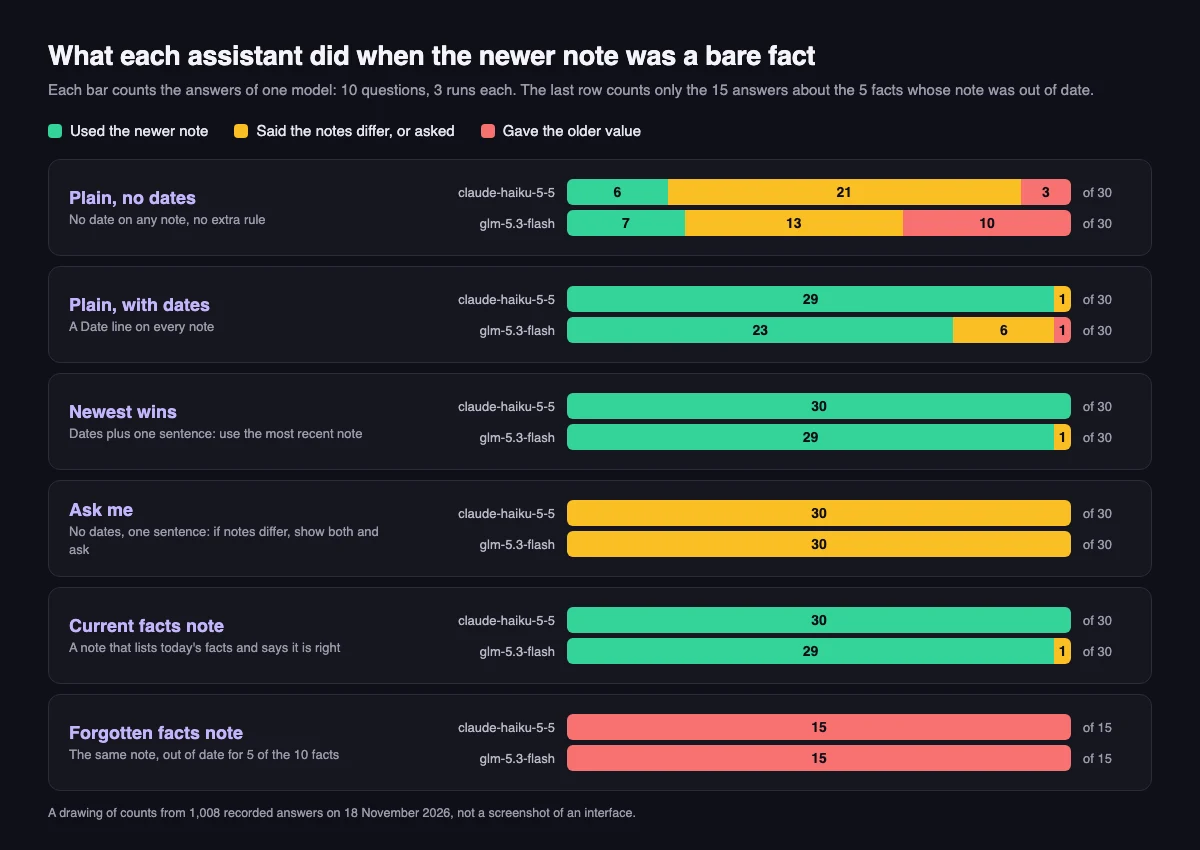
The same counts for both models together, 60 answers per cell unless the row says otherwise:
| Setup | Announced change: older value | Bare change: newer note used | Bare change: notes differ | Bare change: older value |
|---|---|---|---|---|
| Plain, no dates | 4 | 13 | 34 | 13 |
| Plain, with dates | 0 | 52 | 7 | 1 |
| Newest wins | 0 | 59 | 1 | 0 |
| Ask me | 0 | 0 | 60 | 0 |
| Current facts note | 0 | 59 | 1 | 0 |
| Forgotten facts note, the 5 out of date facts (30 answers each) | 13 of 30 | 0 of 30 | 0 of 30 | 30 of 30 |
When the Newer Note Says What Changed
For the ten announced changes the plain setup gave the older value in 4 of 60 answers, all from glm-5.3-flash. In two it read an October rise as one still to come, and in two it treated the new rate as a quote for one client, although the instruction gave today's date. A date on every note removed all four. The words in the newer notes ("goes up", "has left the clinic", "now starts at") did most of the work.
When the Newer Note Is Just a Fact
This is the case that matters, because real notes often just state the value. With no dates and a plain instruction, claude-haiku-5-5 said the notes differ in 21 of 30 answers, used the newer note in 6 and gave the older value in 3. glm-5.3-flash said the notes differ in 13, used the newer note in 7 and gave the older value in 10.
Here is the first kind of answer, from claude-haiku-5-5:
The notes give two dates, and they conflict: ... Note 3 looks like the later update, since it records a call from Omar, but the notes don't say it's a reschedule. Confirm the date with Omar before you rely on either one.
And the second kind, from glm-5.3-flash, on payment terms:
According to your standard contract checklist (Note 3), new contracts should have payment terms of 30 days. ... But for a new contract, your checklist says 30 days.
The second answer also mentions the newer note, which says 14 days. In 60 of the 61 answers that gave an older value, the newer value was somewhere in the answer. The assistant had seen it and led with the wrong one. A careful reader catches that. A reader in a hurry does not.
What a Date on Every Note Did
With a Date line on every note, the plain instruction gave the newer value in 52 of 60 answers, said the notes differ in 7 and gave the older value in 1. Without dates the older value came back in 13 of 60. The two models differed: claude-haiku-5-5 used the newer note in 29 of 30, and glm-5.3-flash in 23, asking in 6.
A date costs one line per note. It was the cheapest change in the test, and it worked for both models.
One Sentence That Changed the Counts
The "newest wins" setup added one sentence to the instruction: use the most recent note, say which note and which date you used, and say so if the notes do not hold the answer. It gave the newer value in 60 of 60 announced changes and 59 of 60 bare ones, and 118 of 120 answers named a date. Here is one:
The workshop is on Saturday 16 January 2027, 10:00 to 16:00, at the Mill Street shop. I used Note 3 (dated 2026-10-27), which is more recent than Note 1 (dated 2026-06-01). Note 1 gave Saturday 12 December, so that date has been replaced.
That answer shows its work, so you can check it against the two notes. It also fits what Cattan and colleagues found: asking a model to reason about conflicts helps. Our version is one sentence, and it only works when the notes carry dates.
The "ask me" setup did what we asked. It showed both values and asked which was current in 59 of 60 announced changes and 60 of 60 bare ones. That is the right setting for notes without dates, with a price: it also asks when the answer was obvious.
The Note That Says "This One Is Right"
A "current facts" note is the strongest fix in this test. When it was right, the assistants gave the right answer in 119 of 120 answers and asked once. When it was out of date for five facts, they followed it: 43 of 60 answers gave the older value. When the newer note was a bare fact, that was all 30 of 30. When the newer note announced the change, 13 answers used it, 4 asked and 13 followed the facts note.
Here is claude-haiku-5-5, on a workshop date:
The Brightside Books workshop is on Saturday 12 December 2026 ... Note 4 gives a different date, Saturday 16 January, from Omar's call. Your current facts note (Note 1) is the source of truth and says 12 December, so I've used that.
The assistant did what the note told it to do. For the five facts whose note was right, the answers were right 60 of 60 times. A single source of truth works until the day you forget to update it. After that it is the most confident wrong answer you will get.
Questions With No Answer, and the Controls
The four questions whose answer was not in the notes each came with a decoy, such as the door code of the old building. In 144 of 144 answers the assistant said the notes do not hold the answer and did not offer the decoy as the answer. The four control questions, with one clean fact each, were right in 144 of 144 answers. A wrong answer in this test did not come from missing information. It came from two notes that disagree.
AI Second Brain Best Practices: Six Habits That Keep It Right
These are the AI second brain best practices that the counts support. None needs code.
- Put a date on every note. Make it the first line, such as "Date: 2026-09-08". Many apps keep a created date somewhere, but the assistant only sees what reaches it as text, so write the date into the note itself. It moved the older value from 13 of 60 answers to 1.
- Say what a note replaces. A line like "This replaces the pricing sheet of January" is the cue that made announced changes work. The newer note did that work in 56 of 60 plain answers even with no dates.
- Tell the assistant what to do when notes disagree. Use the sentence from the "newest wins" setup, or the "ask me" one if your notes have no dates.
- Keep a current facts note only if you will update it. Put a "last updated" date on it and check it every Friday: ten lines take five minutes. If you will not, skip it.
- Make the assistant show its work. Ask for the note and the date in every answer. A checkable answer is what turns a rare mistake into one you catch.
- Keep secrets out of the notes. Passwords and bank details belong in a password manager. The text of your notes goes to the model, as the AI second brain privacy section below explains.
Test Your Own Assistant in 15 Minutes
You do not need our notes to find out how your own assistant behaves. Pick three facts you changed in the last year: a price, a contact, a date. Make sure the old note and the new note both exist in your notes. Then ask your assistant each question in a fresh chat and write down what it did.
| Fact | Used the newer note | Said the notes differ | Gave the older value |
|---|---|---|---|
| Fact 1 | |||
| Fact 2 | |||
| Fact 3 |
Now add a Date line to both notes of each fact and ask again. If the older value goes away, you have your answer. If it stays, add the sentence from the "newest wins" setup. Repeat each question twice, because a model can answer differently the second time.
How to Build an AI Second Brain Without Code
Here is how to build an AI second brain without code in Heym, a self-hosted AI agent platform. The AI second brain setup has three parts: your notes go in, one agent reads them, and an answer comes out. Because Heym runs on your own server, the result is a self hosted AI second brain. Heym gives you four ways to feed the notes in.
- Paste them. The test did this: the notes and the question go in as text. It is the simplest way and fine for a few dozen notes.
- Read them from Notion. The Notion node can search, read pages and query data sources. Share each page the workflow needs with the integration first.
- Read them from Google Drive. The Google Drive node lists and downloads files. The Chat with Drive Docs template is a worked example, and Google Drive Automation explains it.
- Search a vector store. Upload PDF, Word, Excel, Markdown, text, CSV and JSON files in the Vectorstores tab, and a RAG node searches them. The RAG Q&A Agent template does this, and Agentic RAG and How to Build a RAG Pipeline go deeper.
This is the instruction the agent got in the "newest wins" setup, word for word. You can read it before you import anything, and you can change it.
You are the assistant for Nora Vance's personal notes. Today is Wednesday 18 November 2026. Below the question you get the notes that a search of her notes found. Answer her question from those notes. If two notes give different answers, use the most recent one and say which note and which date you used. If the notes do not contain the answer, say so.
Here is the AI second brain template. It is the workflow that ran, with a sticky note on how to use it and a blank credential.
View template JSON
{
  "name": "Ask your notes: the newest note wins",
  "heym": true,
  "nodes": [
    {
      "id": "sb_note",
      "type": "sticky",
      "position": {
        "x": 40,
        "y": -260
      },
      "data": {
        "label": "readMe",
        "stickyTitle": "How to use this",
        "stickyColor": "violet",
        "stickyWidth": 560,
        "stickyHeight": 330,
        "note": "Ask your notes: the newest note wins\n\nThe agent answers one question from notes you paste in. When two notes disagree it uses the most recent one and says which note and which date. When the notes do not hold the answer it says so.\n\n1. Pick your credential and a model on the agent node.\n2. Run it as it is. The text field holds an invented example: notes with a Date line, then a question.\n3. Replace the text with your own notes and question. Keep a Date line on every note.\n4. Edit the instruction: your name and today's date.\n\nThe notes in the example are invented."
      }
    },
    {
      "id": "sb_input",
      "type": "textInput",
      "position": {
        "x": 40,
        "y": 120
      },
      "data": {
        "label": "notes",
        "inputFields": [
          {
            "key": "text",
            "defaultValue": "Note 1: Pricing sheet\nDate: 2026-01-12\nMy standard prices for brand work.\nDay rate: 450 euro. Half day: 250 euro. Brand sprint (three days, one workshop, one deliverable pack): 1,200 euro. Strategy day with a written summary: 500 euro. Travel is billed at cost. Workshops outside the city add 150 euro for the preparation day. Offer the sprint first, the day rate only when a client wants something smaller. Send the sheet as a PDF, never as a spreadsheet.\n\nNote 2: Podcast notes\nDate: 2026-06-18\nEpisode on pricing for freelancers: raise rates twice a year, tell clients early, never apologise for a rise.\n\nNote 3: Call with Harbor Tea\nDate: 2026-09-08\nRosa asked about next year. I told her my day rate goes up in October. Agreed with her: 520 euro per day from 1 October, half day 290 euro. She was fine with it. Send her the updated sheet by Friday.\n\nNote 4: Harbor Tea Co: brand audit\nDate: 2026-04-22\nAudit of the Harbor Tea packaging. The tin lids look the same across the three blends. Suggest colour coding by blend. Rosa Kline, the marketing manager, wants three directions by the end of May. Follow up on the shelf photos.\n\nQuestion: What is my day rate?"
          }
        ]
      }
    },
    {
      "id": "sb_agent",
      "type": "agent",
      "position": {
        "x": 420,
        "y": 120
      },
      "data": {
        "label": "NotesAssistant",
        "credentialId": "",
        "model": "claude-haiku-5-5",
        "temperature": 0.7,
        "systemInstruction": "You are the assistant for Nora Vance's personal notes. Today is Wednesday 18 November 2026. Below the question you get the notes that a search of her notes found. Answer her question from those notes. If two notes give different answers, use the most recent one and say which note and which date you used. If the notes do not contain the answer, say so.",
        "userMessage": "$notes.body.text",
        "outputType": "text",
        "tools": [],
        "mcpConnections": [],
        "skills": [],
        "toolTimeoutSeconds": 30,
        "maxToolIterations": 4,
        "isReasoningModel": false,
        "persistentMemoryEnabled": false,
        "memoryShares": []
      }
    },
    {
      "id": "sb_out",
      "type": "output",
      "position": {
        "x": 800,
        "y": 120
      },
      "data": {
        "label": "Answer",
        "outputSchema": [
          {
            "key": "answer",
            "value": "$NotesAssistant.text"
          }
        ]
      }
    }
  ],
  "edges": [
    {
      "id": "sb_e1",
      "source": "sb_input",
      "target": "sb_agent"
    },
    {
      "id": "sb_e2",
      "source": "sb_agent",
      "target": "sb_out"
    }
  ]
}- Import it. Download the file from the card and drag it onto the Workflows tab.
- Pick a model. Open the agent node, choose a credential and a model, and save.
- Run it from the editor as it is. The text field holds the example.
- Paste your own notes. Keep a Date line on every note, and put the question at the end.
- Edit the instruction. Change the name and today's date.
- Test it on three changed facts, as in the 15 minute test above.
If you would rather not assemble the pieces, Heym Work is the business interface for Heym. To go further with agents and approvals, see Human in the Loop AI Agents and Context Engineering.
AI Second Brain Privacy: Where Your Notes Go
A self hosted AI second brain keeps the workflow, its run history and your credentials on the server where you run Heym. The text of your notes goes to the model provider you choose, because the model has to read it. Choose the provider and the region you are comfortable with, and leave out anything you would not paste into that provider's own chat.
The second privacy question is who can put text into your notes. A web clip or a forwarded email is text from someone else, and a model can mistake text for an instruction. The UK National Cyber Security Centre explains why this is hard to fix, and Simon Willison's lethal trifecta names the three things that make it dangerous: private data, untrusted content and a way to send data out.
The assistant in this guide has the first two and not the third. It can read and answer, and it has no tool to send anything. Add tools and the picture changes, which is why the AI Chief of Staff post tests what happens when an assistant has send tools, and Prompt Injection covers the defences.
What This Test Does Not Show
It was a small test, and it has limits you should know before you rely on it.
- Invented notes. Ten facts, 45 notes and a short, tidy set of questions. Your vault is bigger and messier.
- No search. We handed over the notes a search would return. A real search can miss the newer note, and then the assistant never sees the conflict.
- Two models, one setup. One agent node, no tools, three runs each. Another model or another tool may behave differently.
- Pattern screens, then reading. The first sentence decided the label, and we read the unsettled and the older value answers. We did not read all 1,008 answers in full.
- One question can be read two ways. The day rate question can be read as a rate quoted to one client. Without it, the plain setup with no dates gave 7 of 54 older answers instead of 13 of 60, and the other setups do not change in a way that matters.
Treat the numbers as counts from one small test. The direction should hold for your notes. The exact figures will not.
Date Your Notes First
Two questions come up most: why does my AI second brain give outdated answers, and can I trust my AI second brain? The first is usually two notes that disagree with nothing to say which is newer. The second depends on whether you can check the answer.
Your AI second brain setup is only as current as its notes, and the assistant cannot tell which of two notes is newer unless you tell it. In this test a Date line on every note, one sentence in the instruction and a habit of reading the note and date in each answer mattered as much as the choice between the two models. A current facts note is worth keeping only if you will keep it current.
Your next step is small. Run the 15 minute test on three facts you changed, add the date lines, and import the AI second brain template if you want a place to try it. For the agent side of the same idea, read AI Agent Memory and Self Hosted AI Agents.
Frequently Asked Questions
What is an AI second brain?
An AI second brain is a collection of your own notes plus an AI assistant that searches them and answers in plain language. The notes hold what you know and what you decided. The assistant finds the notes that match your question and writes the answer. You still decide what to believe.
How do I build an AI second brain without code?
Keep your notes as text with a Date line on each. In Heym, import the template in this post, pick a model, and paste your notes and a question into the text field, or read the notes from Notion or Google Drive with their nodes. The agent answers and names the note and the date it used.
Why does my AI second brain give outdated answers?
Usually because two notes disagree and the assistant has to pick one. In our test, with no dates and a plain instruction, 13 of 60 answers to a bare change gave the older value. A date on every note brought that to 1 of 60. A forgotten current facts note made it 30 of 30.
Can I trust my AI second brain?
Trust it as much as you can check it. In our test it was careful with questions it could not answer: 144 of 144 answers said the notes did not hold the answer. It was less reliable when two notes disagreed and nothing said which was newer. Ask it to name the note and the date, and read them.
How do I keep my AI second brain up to date?
Put a date on every note, say what a note replaces, and check one current facts note every Friday if you keep one. Add one sentence to the instruction: use the most recent note, say which note and which date, and say so if the notes do not hold the answer.
Is there an AI second brain template I can import?
Yes. The template in this post is a Heym workflow with a text input, one agent node and an output. It is the setup that ran in the test: dates on the notes and one sentence telling the agent to use the most recent note. Download it from the card, import it, pick a credential and run it.
Is a self hosted AI second brain private?
It keeps the workflow, its run history and your credentials on your own server. The text of your notes still goes to the model provider you choose, because the model has to read it. Choose the provider and the region you are comfortable with, and keep secrets out of the notes.
How is an AI second brain different from RAG?
RAG is a technique: search a collection, then let a model answer from what the search found. It is the whole product around it: your notes, the search and the assistant. This guide tests the last step, what the assistant does with the notes it is given. Our Agentic RAG post covers the technique.
Do I need a vector database for my notes?
Not to start. The test pasted the four notes a search would return, as text. With hundreds of notes you need a search step, and in Heym that is a vector store with a RAG node. A search that misses the newer note hides the conflict, so test the search on its own.
Can an AI assistant replace taking notes?
No. The assistant can only answer from what you wrote down, and an old or wrong note gives an old or wrong answer. Writing and dating the note is still your job. The assistant saves you the searching and the reading.
How much does it cost to ask my notes a question?
In our test an answer used 712 tokens on one model and 386 on the other, including the notes it was given. At example prices of $1 per million input tokens and $5 per million output tokens that is under a quarter of a cent. Your provider's prices will differ.
Sources
- Wikipedia, Personal knowledge management, read on 18 November 2026. The definition of the habit that second brains build on.
- Hacker News, "I deleted my second brain", posted on 28 June 2025, 598 points when read on 18 November 2026.
- Stack Overflow Blog, AI is becoming a second brain at the expense of your first one, 19 March 2026.
- Jie Ouyang, Tingyue Pan, Mingyue Cheng, Ruiran Yan, Yucong Luo, Jiaying Lin and Qi Liu, HoH: A Dynamic Benchmark for Evaluating the Impact of Outdated Information on Retrieval-Augmented Generation, arXiv, submitted 3 March 2025, revised 18 July 2025.
- Arie Cattan, Alon Jacovi, Ori Ram, Jonathan Herzig, Roee Aharoni, Sasha Goldshtein, Eran Ofek, Idan Szpektor and Avi Caciularu, DRAGged into Conflicts: Detecting and Addressing Conflicting Sources in Search-Augmented LLMs, arXiv, submitted 10 June 2025.
- GitHub, obsidian-second-brain: the vault retrieval benchmark, read on 18 November 2026. A reproducible measurement of whether search finds the right note in a synthetic 300 note vault.
- Taskade, 11 Best AI Second Brain Tools in 2026, read on 18 November 2026: the weekly check for contradictions and stale claims.
- NextWork, Build an AI Second Brain with Claude Code, read on 18 November 2026: the rule that a page names a disagreement between sources.
- Meta Engineering, An Organizational Second Brain: Building an AI That Learns From Experts, 2 September 2026.
- UK National Cyber Security Centre, Prompt injection is not SQL injection (it may be worse), by Dave Chismon, published 8 December 2025.
- Simon Willison, The lethal trifecta for AI agents: private data, untrusted content, and external communication, 16 June 2025.
- Heym 0.0.163. Documentation: Agent node, Notion node, Google Drive node, RAG node, Vectorstores tab.
- Our reading of 111 pages on 18 November 2026: the pages on 12 Firecrawl search result lists and one Brave list for second brain queries, 59 more pages from the four sites with the most second brain pages, and 5 pages that answer engines cite. The patterns were N out of M questions, answers, runs, tests, notes, cases, setups or vaults; a percentage of answers, queries, questions, responses, retrievals or results; recall@k, precision@k, hit rate and MRR; "we" or "I" tested, measured, ran, counted or benchmarked; and any percentage within 160 characters of stale, outdated, out of date, superseded, contradict or conflicting.
- Our runs of 18 November 2026: 28 questions, six setups, three runs each, two models, Heym 0.0.163 on a scratch database, 45 invented notes, 1,008 answers, no failed calls. The scripts and the stored answers are in our research folder.
Steps at a glance
- Import it. Download the file from the card and drag it onto the Workflows tab in Heym.
- Pick a model. Open the agent node, choose a credential and a model, and save.
- Run it from the editor as it is. The text field holds an invented example: notes with a Date line, then a question.
- Paste your own notes. Keep a Date line on every note and put the question at the end.
- Edit the instruction. Change the name and today's date in the instruction.
- Test it on three changed facts. Ask about three facts you changed, with and without the Date lines, and compare the answers.

Co-founder & Engineer
Burak is a co-founder and engineer at Heym, focused on backend infrastructure, the execution engine, and self-hosted deployment. He builds the systems that make Heym's AI workflows run reliably in production.
Reviewed by Ceren Kaya Akgün. Statistics cite named, dated sources, and claims about Heym are verified against the source code before publication. See our editorial policy or report a correction.
Enjoyed this post? Get the next one in your inbox.
A monthly note with practical ideas for building AI workflows that hold up in production. No noise, and you can unsubscribe anytime.